
Mamiya 7 II 6x7 Medium Format Rangefinder
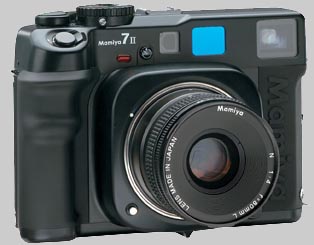
Since people come to this site as much for info about the Mamiya 7 as for large format info, I'll try to keep this info updated as much as possible.
News
Feb 2012: I've let the Mamiya 7 sit in its bag for about the past 4 or 5 years while I made an earnest (and expensive!) attempt to wrap my head around digital capture and workflow. While I like some aspects of digital (e.g. fairly easy proof printing) I've come to the conclusion it isn't really that satisfying for me. So, I'm going to sell my Nikon D3 and maybe the Leice M8. I'm sending my Mamiya 7ii kit and my 4x5 off to Precision Camera Works for a complete CLA on everything. Once they're back, I'll thaw out some film and start taking photos again. Hopefully, I'll have some new pictures to put up on Flickr before too long.
The Mamiya 7II is a 6x7 medium format (56mm x 69mm image size) rangefinder camera system with 6 available lenses. I've had mine since the fall of 2001 and have exposed a fair number of rolls with it. Hopefully the observations that follow will be helpful to those contemplating a purchase.
I've found it to be just about perfect for all of the hand-held photography I do. It has a set of the best lenses in any format (as far as MTF measurements go, anyway). See http://www.photodo.com/nav/prodindex.html for the test data. Also, it is light enough to carry easily (it's 2.8 lbs w/80mm lens attached).
Using the Camera
The Mamiya 7ii has a very nice, solid feel in your hand. You can tell that everything is put together solidly by just holding the camera in your hand. The controls are laid out well, attesting to the simplicity of its design. It is easy to use, lacking the oversupply of electronic gizmos that detract, in my opinion, from the essential task of taking photographs.
Exposure
See cool viewfinder pix at the Mamiya UK site. There is much better info on the camera there compared to the US site, even though Mamiya America Corp. apparently makes a much higher profit on its sales.
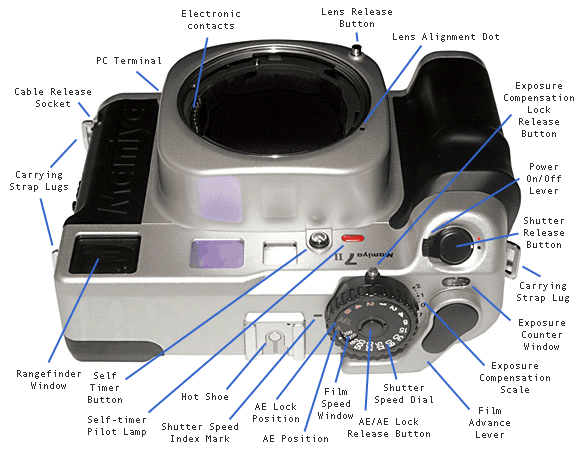
Shutter speed and film speed are set via the dial at the top of the camera (see photo below). There are two automatic exposure modes. The "AEL" (auto-exposure locking) mode is likely the most often used automatic mode. With that, you aim the metering patch in the viewfinder (it's not marked, but is a bit below the center rangefinder square) at an appropriate spot in the scene being photographed, you half-press the shutter button to lock the meter at that reading, then recompose while keeping the button half-pressed, and trip the shutter when you have everything set. This mode works very well for most handheld photography. Since most of my exposures are tripod mounted, though, I use the manual shutter speed setting along with the appropriate aperture setting derived by using my handheld spot meter.
The camera accepts a standard cable release in the lower front left corner of the body. It's an unusual place for a cable release, but it works well as it is out of the way of the exposure controls. For those time when you can't find your cable release there is an easy to use self-timer.
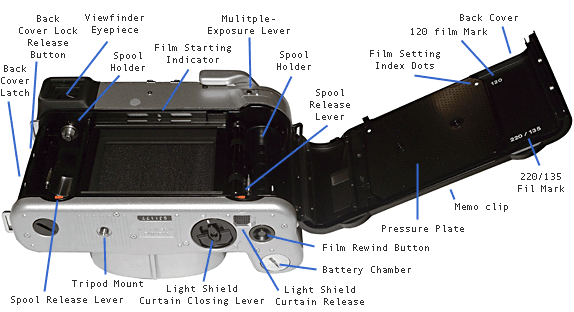
One thing a lot of people mention as a problem when stepping up to MF from 35mm is that with 120 roll film you only get 10 exposures per roll with a 6x7 camera. While this is true, the Mamiya 7 is also capable of handling 220 roll film with just a twist of the pressure plate. I tend to prefer 120 after having standardized on 220 Tri-X for a while, since the shorter roll usually means unexposed film sits in the camera for shorter periods of time until I can finish it off. I still keep some 220 around for those times I might be shooting in higher volumes.
Lenses
The lenses for this system are as good as everyone says they are. One thing I'd like to comment on is that with all the hype about the 43mm lens, one should be careful that you'll actually use a lens that wide. The physics are such that while some types of distortion have been minimized, there is still the usual wide-angle distortion of shapes as you get closer to the edges. For example, see my Pillsbury 'A' Mill Elevator. You'll note that the tall structure in the upper left appears a little flattened out and elongated. It's not a big issue if you're aware of it, but is more apparent with circular things (they tend to come out elliptical). Unfortunately it's a characteristic of wide angle lenses and is a problem even in very high-quality large-format lenses. It's physics. Not much you can do but work around it.

Rangefinders
I think that people find the fact that the 7II is a rangefinder camera to be the biggest hurdle, or biggest unknown, when deciding whether to commit to it, and for good reason. I had never owned a rangefinder prior to the '7', but took the plunge anyway. There are several things to consider before deciding to buy a rangefinder camera.
No extra long lenses
Those coming from SLR camera systems might find it odd that the longest useful lens for this camera is 150mm, or about the same as a 75mm on a 35mm camera. The 210mm lens is not recommended for general photographic use, as it is not coupled to the rangefinder mechanism, so focusing would be a guess except at infinity. The major issue with long lenses and with rangefinders is that the longer the lens, the harder it is to focus. You can compensate with Leica's by getting a viewfinder magnifier. It would be nice if Mamiya did that, too.
No through-the-lens (TTL) viewing
This can be frustrating if you've never used a rangefinder before. I don't know how many shots of the inside my lens caps I've taken! With this camera, it becomes far more important to follow a habitual procedure for taking photos.
Parallax
Parallax is an attribute of all rangefinder cameras. Its the result of having the viewfinder—what you look through to compose the photo—and the lens offset by some distance. The result is that what you see and what the lens is seeing are a little different. The offset is more an issue the closer the object being photographed is to you, although be careful to realize that a foreground object's relative position to a distant background object will be offset by this, too. It's just something to bear in mind when using rangefinder cameras. The Mamiya 7 has some parallax compensation in that focusing will cause the bright lines to shift to show you the adjusted composition. That doesn't do a thing for the near-far placement problem, though.
Filter use
Also, you really can't use gradient filters with a rangefinder, since it's impossible to judge the placement of the filter transition area relative to the scene your shooting without TTL viewing. Also, if you want to use a polarizer, you're pretty much stuck with the Mamiya one. That one flips up so you can judge the effect & meter through it. Otherwise, most filters aren't so much of an issue. The filter threads are either 67mm or 58mm. If you prefer (or already have) glass screw-in filters, you'd probably be best off with a step-up ring. I tend to use 4x4 gels or resin filters with a cheap holder that grips the lens with a big rubber band. It works fine and only costs about $20.
Benefits
- Lenses of spectacular quality, each one is close to the best of any format. Don't trust me, see the tests: http://www.photodo.com/nav/prodindex.html. Even better, try to rent one and see for yourself.
- Super quiet shutter release due to the leaf shutter. It is much quieter than even the Leica M cameras.
- Bright view finder, but see Quirk #5 below.
- Smaller and lighter than a 6x7 medium format SLR. The M7-II is 2.6 lbs for body and 80mm lens, but the RB67 ProSD weighs nearly 6 lbs with 127mm lens, and about 4 ¾ lbs for the Pentax 67II with 105mm lens and pentaprism.
- Did I mention the remarkable optics?
- Takes both 120 and 220 roll film with just a rotation of the film pressure plate.
Quirks
- The built-in light meter is heavily center weighted, but the metered area varies in size with he focal length of the lens attached. That means that for the super-wide 43mm lens the meter is almost a spot meter, and with the 150mm lens it is a full frame averaging meter. I almost always use my external Pentax spot meter for exposure metering, since I'm used to it. I have used the internal meter, though and find it works just fine if you just take its characteristics into account.
- I had some problems early on with film take-up not winding tightly by the time I got to the end of the roll. I think it was due to mixing film types & trying to use a Fuji reel for Kodak film or maybe vice versa. Never spoke to anyone else who had this happen, so it's probably just me. I have not had this issue when using only one type of film (I use Tri-X, mostly).
- The biggest disadvantage of the leaf shutter is that lens changes can be a bit cumbersome. You have to manually close the shutter curtain, remove the lens, replace it, and release the shutter curtain. It's a bit tedious if you change lenses very much.
- The thing to remember about film loading is to line up the registration marks on the film leader—the advance lever will be at about half-way through it's second or third full stroke at this point—then, close the back, and wind the film advance lever until it stops (when the counter reaches '1'). For 220 film, which has two registration marks, use the second, solid line one (same as the 120 mark), not the dotted line, which is the first set of marks you see.
- If you take photographs in temperatures below about 20F (-7C) for extended periods of time, I recommend the external battery holder. It's basically a battery-on-a-wire that lets you tuck the battery in your clothes where it is warm & keeps the battery from weakening in the cold. The wire is about 4.5 feet long.
- The viewfinder is polarized, so you may not be able to see through the viewfinder with polarized sunglasses on (but why would you be phtoographing with sunglasses on?).
- With the 43mm and 50mm lenses, you have to use an external viewfinder to frame your shot. You just have to get used to focusing with the built-in viewfinder, then framing with the external viewfinder. I've heard, though, that with the 50mm you can just use the full viewfinder frame as a rough guide (no paralax correction that way).
- Every 6-12 months, clean the lens contacts (both on the lens and body of the camera) with a pencil eraser to remove any dirt or corrosion build-up. Dirt can cause the camera to malfunction and usually is the cause of shutter malfunctions. Be sure not to get any eraser stuff inside the camera or lens.
I send in my Mamiya 7ii (and my Arca Swiss 4x5) to Precision Camera Works (PCW) in Chicago for CLA (clean, lube & adjust) periodically. They've done basic CLAs and repairs for me (replaced leaky dark slide curtain). Last time Bob at PCW recommended I send all my lenses in with the camera to get the infinity stops adjusted, since he'd noticed that the 80mm was off a bit. The work was well done and at a reasonable price and it only took a couple of weeks.
Here are some pictures I have taken with the Mamiya 7ii using various lenses. Be aware that it is not possible today to come anywhere close to reproducing the resolution of the images on a computer screen, but people have asked for this, so here it is.
- Yosemite (65mm lens)
- Badlands (43mm lens)
- Badlands Sunset (43mm lens)
- Barn Door (80mm lens)
- Sand Pile (65mm lens)
- Rain spout (65mm lens)
- Silo sheds 1 (65mm lens)
- Silo sheds 3 (65mm lens)
- Pillsbury 'A' Mill Elevator (43mm lens)
- Rail Yard (65mm lens)


Some Mamiya 7 resources on the 'net:
- Get your Mamiya 7 CLA'd by Precision Camera Works in Chicago. A good alternative to sending it to Mamiya America Corp. I used them for a CLA last Spring and was very pleased with the service. They also do rangefinder adjustments at a very reasonable price, if you don't need a full CLA.
- Mamiya USA
- Mamiya USA user forum (defunct)
- Emergency field rangefinder adjustment (use at your own risk! Will probably void warranty!)
- Mamiya UK (including an excellent web page on the '7')
- Robert White, UK (reseller, usually better Mamiya prices than in the US, depending on current exchange rates, but read their warranty policy.)
- Photo.net's Mamiya 6/7/7ii discussion group archive
Camera function, Front (photos from the Mamiya UK site):
| Specifications | |
|---|---|
| Type | 6 x 7 format rangefinder with interchangeable lenses |
| Format | 6 x 7cm (56 x 69.5mm with 120 or 220 roll film) |
| Multi-formats | Optional interchangeable panoramic insert mask yields 65 x 24mm (2.7:1) with 35mm roll film. |
| Lenses | 43mm f4.5 w/optical viewfinder & lens hood, 67mm filter 50mm f4.5 w/optical viewfinder & lens hood, 67mm filter 65mm f4 w/lens hood, 58mm filter 80mm f4 w/lens hood, 58mm filter 150mm f4.5 w/lens hood, 67mm filter 210mm f8 w/lens hood, 58mm filter (210mm is not rangefinder coupled) |
| Shutter | Electromagnetic
full flash synch lens shutter 4 sec. - 1/500 sec., B X synchronization at all speeds Hot shoe Synch-socket Self canceling self timer |
| Metering | Built-in metering ±2 stops by 1/3 stop increment exposure compensation dial Aperture Priority AE or AEL manual metering modes |
| Viewfinder | Rangefinder coupled Automatic parallax compensating Automatic bright line selection (65mm, 80mm, 150mm) Readout shutter speed LED indicator Separate ultra-wide optical finder supplied with 43mm and 50mm lenses |
| Power | One 6V PX28 alkaline or silver oxide (4SR44, 4LR44) battery |
| Dimensions/Weight | 159 x 112 x 123mm
(6.2 x 4.4 x 4.8") 1210 g. (2.6 lbs.) with 80mm lens |
Site contents are
Photographs licensed under a
Creative Commons Attribution-NonCommercial-ShareAlike 4.0 International License.

All trademarks and logos belong
to their respective owners.
Page last modified:
23-Jan-2018